Inclusion and Protection of Gender and Sexual Minorities
We are launching this pivotal protection blog series to draw attention to the urgent and diverse protection issues young people in development, peace and security work are facing on a daily basis. In this blog post, we look at the inclusion and protection of gender and sexual minorities, drawing from the insights of a panel of youth practitioners and activists in this area, who shared their experiences, needs, and ways forward.
Topic introduction
In an effort to meaningfully address the unique protection issues facing young people in development, peace and security work, Search for Common Ground and the United Network of Young Peacebuilders are initiating monthly conversations within Youth Excel on different protection-related topics.
The first iteration of this series focused on the inclusion and protection of gender and sexual minorities. We know that LGBTQI+ youth face multiple exclusions and threats, as was shared in the Global Report on Protecting Young People in Civic Space:
Trans, non-binary and gender diverse young people are misgendered and being referred to with their dead names (the names they are given at birth but not using anymore and with which they do not identify). Why would you engage in a space that denies your identity?
This question captures the inherently intersectional nature of protection and participation. To better understand who LGBTQI+ youth are, the common challenges they face, and some of the opportunities in working with or supporting them, we heard from Mithela Haque, Peace Practitioner at Inclusive Bangladesh, and Jorge Valderrábano, UNOY Regional Coordinator for the Americas and Co-Founder of Ágora Mexico.
Panel highlights
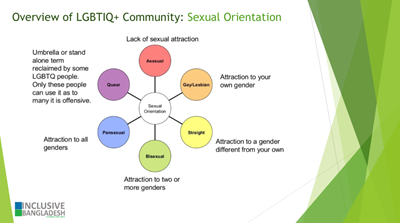
Mithela provided an overview of LGBTQI+ identities and expressions, highlighting the fundamental importance of human dignity: “The first step towards inclusion is simply giving the choice of pronoun and gender identity.” As someone’s gender identity might not be immediately obvious, it should become common practice to share your pronouns and ask people for theirs. This not only creates safe, inclusive spaces, but also validates LGBTQI+ identities that are often marginalised and denied space to exist and thrive.

Jorge shared their experiences as a non-binary person with a gender-fluid expression, working towards inclusive education with Dilo and increasing the participation of young people in decision-making with Ágora and UNOY. Growing up in the second most violent country in the Americas for the LGBTQI+ community, Jorge emphasised their work on safe and inclusive access to education on sexual and reproductive health and rights in the region: “Schools not only need inclusive bathrooms, but a wider programme to facilitate an inclusive environment in the whole school for LGBTQI+ youth”.
Q & A
To Mithela: what is the response and openness of the population with whom you work in Bangladesh, since there is limited support from the government?
It is not always easy to work with the LGBTQI+ community in Bangladesh. There are people who are open and responsive when we work with them. But in some localities and communities, it takes time. And while there is a long way to go in working with the government, I see changes and willingness from their side to include gender minority communities in society through skill development and economic opportunity training. In the meantime, Inclusive Bangladesh continues to advocate with stakeholders and support the LGBT+ community in Bangladesh.
~ Mithela Haque, Inclusive Bangladesh
To Jorge: what resistance have you found from parents in schools?
I would say that families are by far one of the biggest barriers to talking about these issues in schools, but now we have a workshop for families too, so they know how to talk about diversity and sexuality at home.
~ Jorge Valderrábano, Ágora Mexico
Lessons learnt from a Youth Excel protection case
If gatekeepers are homophobic, how do LGBTQI+ youth get past the gate?
In any context, LGBTQI+ youth might be exposed to violence and exclusion from their peers, colleagues, families, educators, and professional society. So, when we talk about meaningful youth participation and design programming to this end, we must address the protection and inclusion of young people in their incredible diversity. We were privileged to hear the powerful testimony of a bold young leader in the Democratic Republic of Congo, who shared invaluable lessons on how to protect and include LGBTQI+ youth:
- Integrate socio-psychological support and legal protections for LGBTQI+ youth at all project cycles (beginning, during, and after);
- Facilitate safe spaces for collective activities, such as awareness-raising and group discussions. Such spaces will provide a sense of assurance that LGBTQI+ youth are safe and can participate with pride;
- Include specific training on gender inclusion, LGBTQI+ respect, and integrity for implementing partners in your project;
- Where possible, provide financial means for LGBTQI+ youth start-ups, to empower them and reduce their vulnerability;
- Strengthen protection services and access to them.
What next?
When it comes to the inclusion and protection of gender and sexual minorities, here are 3 main takeaways for what we can all do next:
- Learn about and recognise the myriad of gender and sexual identities, and actively offer safe spaces for their expression.
- Listen to and create safe spaces for LGBTQI+ youth’s experiences, concerns, and needs to be heard.
- Secure resources for LGBTQI+ youth, to support psychosocial wellbeing, legal protection, and financial empowerment.
Resources
From The International Lesbian, Gay, Bisexual, Transgender, Queer & Intersex (LGBTQI) Youth and Student Organisation
From the European Salto Youth Network
From the European ILGA network
From the US Government for US context
On bullying but in US context
From the Council of Europe on addressing GBV affecting young people
From the Mediterranean Institute of Gender Studies on empowering youth to prevent GBV through peer education
Resource Mobilization Toolkit for Girls, Young Women and Trans Youth from FRIDA fund
From the Urgent action fund for women’s human rights
Toolkit from Advocates for Youth on Creating Safer Spaces for LGBTQ Youth
Pivotal Protection Blog Series, Youth Excel: Our Knowledge, Leading Change
Written by
Charlotte Davidi, Communications & Protection Lead at UNOY Peacebuilders
This article is made possible by the generous support of the American people through the United States Agency for International Development (USAID). The contents are the responsibility of Search for Common Ground and UNOY Peacebuilders and do not necessarily reflect the views of USAID or the United States Government.
The header artwork used in this blog has been remixed, but is the original artwork of Sebastian Rubiano for Fine Acts. The artwork was found on The Greats: a free vault with carefully curated socially engaged visual content open to anyone to use or adapt non-commercially for free under a Creative Commons Attribution-NonCommercial-ShareAlike 4.0 International license.