Nigeria’s Roadmap Towards the Localisation of the Youth, Peace, and Security Agenda
People who soar are those who refuse to sit back, sigh and wish things would change. They neither complain of their lot nor passively dream of some distant ship coming in. Rather, they visualize in their minds that they are not quitters; they will not allow life’s circumstances to push them down and hold them under.
~ Charles Swindoll
The journey towards Nigeria’s National Action Plan on Youth, Peace and Security
As we penned down this article, the quote above from Charles Swindoll, a famous educator and author is a true reflection of our hearts and minds and that of many young people across Nigeria about the state of youth, peace and security and the domestication of United Nations Security Council Resolution 2250 in Nigeria. Unlike our previous exclusion, Nigeria youth are beginning to establish themselves as critical stakeholders in the peace and security spectrum of the nation as encouraged with the adoption of UNSCR 2250 and recently complemented by the African Union Continental Framework on Youth, Peace and Security.
When the United Nations Security Council (UNSC) adopted Resolution 2250 on Youth, Peace and Security on the 9th December 2015, not so many would have thought that Nigeria would be among the first countries to come up with a concrete national road map for the operationalisation and domestication of the youth, peace and security agenda. Alas, on the 1st November 2021, Nigeria officially launched her National Action Plan (NAP) on Youth, Peace and Security, becoming the second country in the world only behind Finland to achieve this feat.
For several youth organizations like the Building Blocks for Peace Foundation, the importance of a NAP cannot be overemphasized in the overall attempt to localize the United Nations Security Council Resolution 2250 because it creates the basis for cooperation among various stakeholders connected to the YPS agenda and also highlights government’s commitment and accountability to supporting young people’s efforts on conflict prevention and peacebuilding in Nigeria.
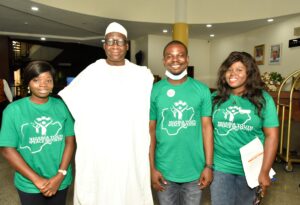 The journey of Nigeria’s National Action Plan on Youth, Peace and Security started way back in 2016. Shortly after the UN adoption of 2250, stakeholders including CSOs, Youth Groups, UN entities, Ministries of Government gathered at various locations both in Ibadan and Abuja in their numbers for the official launch of UNSCR 2250 in Nigeria. These regional launches presented opportunities for stakeholders mobilization and education about the existence of UNSCR2250 and served as the official commencement of the journey of the NAP.
For many young people at the local level in Nigeria, the adoption of the UNSCR 2250 provided a platform to participate actively in peacebuilding and support violence prevention interventions. The awareness of the resolution and its provisions brought more youths into the peacebuilding sphere, with several of them establishing both formal and informal networks and groups to help them make an impact in their community in several sectors.
Nigeria’s National Action Plan on Youth, Peace and Security was achieved after serious advocacy and lobbying coupled with rigorous dialogues and consultations among youth groups and youth stakeholders, hosting of several Youth4Peace conferences and summits; organising in-person consultations in the form of zonal workshops, community-level focus group discussions, online consultations and meetings; and national validation meetings across Nigeria that lasted for about five years. In 2020, as part of efforts to provide empirical evidence and an advocacy tool, BBFORPEACE produced a research documentary titled ‘Connecting and Amplifying Voices of Youth Building Peace in Nigeria which serves as an advocacy tool during the processes that led to the adoption of the NAP.
Practical steps/tips other young peacebuilders can take to push for NAP
Some of the lessons from the entire process that ensured the achievement of this feat was the establishment of a coordinating platform and alliance building. In the case of Nigeria, we had a national coalition that was driving the conversation and tracking progress. This was important to galvanize all little efforts that are being made by youth stakeholders across countries towards the vision of pushing and achieving a NAP.
Campaigns and awareness both online and offline played a major important role in keeping the hope alive and sustaining the momentum. Social media hashtags like #NigeriaYouth4Peace #ActOn2250, #Yes4YPS, #Youth4Peace, were also used by youths to call for the domestication of the UNSCR 2250 in the country.
 Build partnership and see Government as a partner in progress. The result of all advocacy campaigns bore fruit in November 2021 when the Nigerian government launched its first National Action Plan on Youth, Peace, and Security. The NAP is intended to serve as a useful guide to Federal, State, and Local Governments, as well as other non-governmental stakeholders, to ensure that their various programmes address youth needs in all the pillars of the UNSCR 2250.
Action-oriented messages: now that it is adopted, what about implementation?
For us, the adoption of a NAP is not an end in itself. However, it is a major step forward in the operationalisation of the youth, peace and security agenda in Nigeria. The successful implementation of the NAP must translate to young people having all the needed support to contribute to the peace process and also achieve their life aspirations.
Hence, localizing the YPS agenda requires a multi-stakeholder and a comprehensive approach. Government, CSOs, Youth groups, Media, Academia, Donor community, INGO, religious leaders, Security agencies and other relevant entities must come together if this would be achieved.
As young peacebuilders in Nigeria, we would continue to mobilise and empower our peers for peacebuilding and remain focused on the advancement of the youth, peace and security agenda in Nigeria.
References
- FMYSD. (2021). Nigerian National Action Plan on Youth, Peace, and Security: An Adoption of UNSCR 2250, 2021-2024. Nigeria: Federal Ministry of Youth and Sport Development.
- Lawal, R.A., Akhigbe, A.O. and Effevottu, E.S.(2020). (Eds). Connecting and amplifying voices of youth building peace in Nigeria. Nigeria: Building Blocks for Peace Foundation. https://bbforpeace.org/publication/Connecting%20and%20Amplifying%20Voices%20of%20Youth%20Building%20Peace%20in%20Nigeria.pdf
- UNSCR 2250. (2015). UNSCR 2250 on Youth, Peace and Security. New York: UN.
Written by
Stephanie Effevottu and Rafiu Adeniran Lawal from Building Blocks for Peace Foundation, Nigeria