2022 European Year of Youth: It’s Time the EU Prioritised the YPS Agenda
In 2019, UNOY Peacebuilders published a study mapping the progress on the implementation of the Youth, Peace, and Security (YPS) agenda in the European Union (EU).
The study highlighted the EU’s support of youth-led peacebuilding and identified the existing gaps in the implementation of the YPS agenda. It covered a wide range of topics; from the perception of youth in the EU to the actions taken by member states, to the implementation of the YPS agenda. The study also mapped the development since the adoption of the United Nations Security Council Resolution (UNSCR) 2250 in 2015 and looked at the EU’s engagement with youth stakeholders.
The study concluded that the YPS agenda has gained momentum but that commitments related to YPS are still not widespread, and are limited in their reach within the EU.
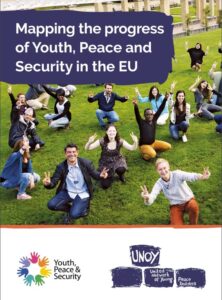
Since its publication in 2019, it is worth considering what has changed in the EU. This reflection is even more interesting since 2022 has been declared the European Year of Youth. The Civil Society Dialogue Network (CSDN) policy meeting on the ‘EU’s implementation of the YPS agenda: gathering young experts’ Recommendations’ provides an opportunity to look at what the EU has done so far to implement the YPS agenda. The meeting brought together young civil society experts and officials from the European External Action Service and the European Commission. The published recommendations can be viewed here.
Negative perceptions and assumptions about youth can lead to their further exclusion from decision-making mechanisms and a seat at the table during peace processes. Youth are too often perceived as a homogeneous group without taking into account the intersectional identities young people have. A further problem is the securitisation of the agenda—as stated in UNOY’s study, young people are often mentioned in the context of violent extremism. Similarly, the CSDN report advises the EU to move away from a state-centric understanding of security towards a more youth-sensitive approach and adopt a youth-lens in programming.
The lack of institutional commitments made in regards to the YPS agenda has effects on how Member States perceive and prioritise the agenda. The study found that most commitments and progress made regarding the agenda have been due to individual commitments rather than EU-wide commitments. Still today, the EU lacks adequately resourced and trained youth focal points.
The YPS agenda will only ensure its sustainability and successful implementation if it can secure ongoing space within the permanent bodies of the EU. That will help to move away from its dependence on the priorities of the regularly changing presidencies.
~ Mapping the Progress of Youth, Peace and Security in the EU, p. 17
Young people are too often tokenised or only symbolically given a seat at the table. For the successful implementation of the YPS agenda, young people must have the opportunity to engage meaningfully. The report, therefore, calls the EU to “ensure that young people can participate meaningfully in the design, implementation, monitoring, and evaluation of its programming and engagements” (p. 3). The EU has the responsibility to create inclusive spaces for young people to engage and to promote the inclusion of all young people regardless of their identity.
Young people do not yet play a meaningful role in policy-making.
~ Mapping the Progress of Youth, Peace and Security in the EU, p. 6
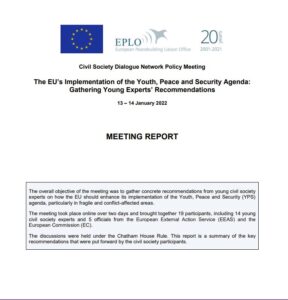
Both the study and report call for adequate funding mechanisms for young people and youth-led organisations. The study highlights the Erasmus+ Programme as an opportunity for young people and youth-led organisations to access flexible funding. However, other funds dedicated to peace and security often lack a youth lens. The inability to access funding remains one of the main barriers and challenges young people face in their attempt to build peace in their communities. Youth-led organisations operating at the community level often have to respond to emergencies and crises. The implementation of the YPS agenda can only be sustainable if not only big organisations but also youth-led organisations working at the community level can access those funds. The report further points out that young people should not only be seen as beneficiaries of funding but as implementation partners. Funding needs to be flexible, and adapt to the needs and priorities of young people.
The EU can only make the ‘Year of Youth’ truly meaningful for young peacebuilders by following the recommendations and following up on the commitments made during the EU-AU Summit by establishing concrete action points for the implementation of the YPS agenda. It is therefore time the EU engaged with young people not only in Europe but across the world. Young people continue to promote peace in informal settings with no protection. The COVID-19 pandemic has increased the challenges young people face in building peace, and nevertheless, they continue to do so around the world, in their communities and across borders.
Reference
Full statement can be read here: 6th EU-AU Summit: A Joint Vision for 2030
UNOY Peacebuilders (2019). Mapping the progress of Youth, Peace and Security in the EU, The Hague
Written by
Freya Scharrelmann, Advocacy Officer at United Network of Young Peacebuilders (UNOY Peacebuilders)