Tackling Ageism as a Bystander
In the second iteration of this pivotal protection blog series, we draw attention to age-based discrimination and harassment. Functioning in the same way as other forms of discrimination and harassment, ageism can have serious implications on young people’s political and civic participation, sociocultural wellbeing, and can even pave the way for physical threats. In this blog post, we offer ways to tackle ageism as a bystander, using the 5Ds developed by Right To Be.
Topic introduction
The most pervasive threats that young people face around the world are socio-cultural. Of the young people surveyed for the first Global Report on Protecting Young People in Civic Space, 90% said that they face sociocultural barriers, which range from intergenerational hostility to media stereotyping of youth and incitement to violence against youth. To tackle the multiple violence of exclusions young people face, we need strong allies:
We receive a lot of jokes, intimidating comments when we are trying to present our opinion in official meetings. We see sometimes attempts to diminish and undermine what we have to say.
~ Young woman from Western Asia
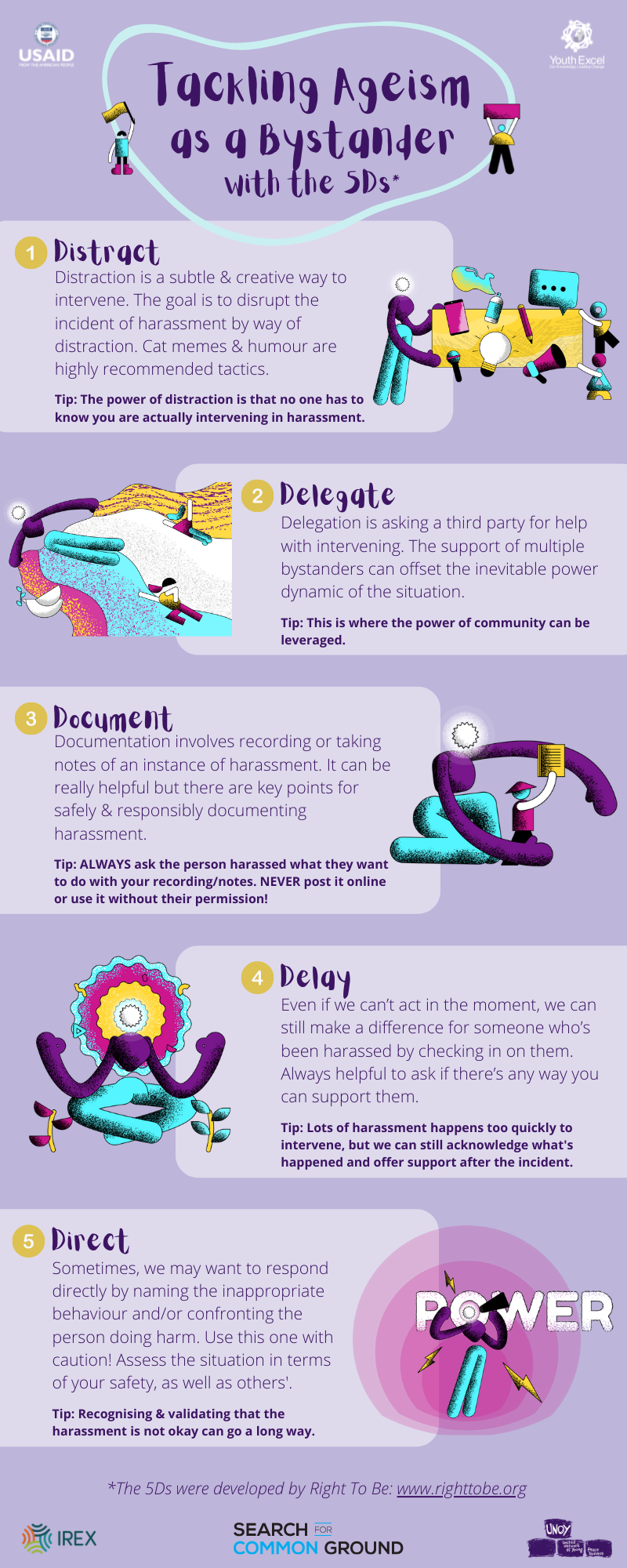
Resources
From PEN: Online Harassment Field Manual for Allies and Bystanders (in EN, FR, SP)
From Communities Inc: Bystander Awareness Resources & Poetry Video
From Right To Be: Bystander Intervention Training & Resource Library
From Heart Mob: Support for those Experiencing Online Abuse
From Buzzfeed: What To Do When You See Islamophobia
Pivotal Protection Blog Series, Youth Excel: Our Knowledge, Leading Change
Written & designed by
Charlotte Davidi, Communications & Protection Lead at UNOY Peacebuilders
Infographic illustrations by
Cesar Duarte
This article is made possible by the generous support of the American people through the United States Agency for International Development (USAID). The contents are the responsibility of Search for Common Ground and UNOY Peacebuilders and do not necessarily reflect the views of USAID or the United States Government.
The header artwork used in this blog has been remixed, but is the original artwork of Dumitru Ochievschi for Fine Acts. The artwork was found on The Greats: a free vault with carefully curated socially engaged visual content open to anyone to use or adapt non-commercially for free under a Creative Commons Attribution-NonCommercial-ShareAlike 4.0 International license.