Bridging South Asian countries when the world stayed at home
Before 2020, I don’t think anyone would have thought about completing a 10-month-long research programme entirely online. It all started on a mid-August evening where 8 young researchers from Bangladesh, India, Pakistan and Sri Lanka met the coordinating team for the first time.
The first week was fairly formal as we started to get to know each other, and probably we were trying to hold a serious image of ourselves. Without a single moment in the entire 10 months where I felt disengaged, this initiative is setting a unique trend in developing the capacities of young peacebuilders as researchers. In fact, it was the triple impact of Felix, Mridul and Jaakko [programme facilitators and coordinators], who didn’t leave any stone unturned to ensure a smooth journey for us young researchers.
My first point of connection was with my fellow Bangladeshi researcher, Sumaiya. We worked together to engage eligible young peacebuilders even from the most remote corners of the country. I remember conducting an online interview at midnight, where Sumaiya patiently observed for more than an hour. In fact, the same commitment was true of all the young researchers.
For me, the team spirit that all eight of us showed throughout the programme has best reflected the essence of this participatory action research.
The initial sessions were all about understanding the contexts and theories regarding violence and peacebuilding that we were going to use for the research. Starting from the basics, I learnt most of the major techniques that can be applied to similar research projects in future. The level of dedication that each of us showed has been the greatest influence. I remember Shafaq attending the sessions amid an earthquake in Islamabad, as well as during nationwide power outages. Ritu was actively contributing to the discussions even while waiting to board her flight at Jaipur Airport. Salal and Janith tried to stay connected when there was heavy rainfall and disrupted networks in Karachi and Colombo; and when things didn’t go according to her plan, Kaush admirably managed and navigated the scenario.
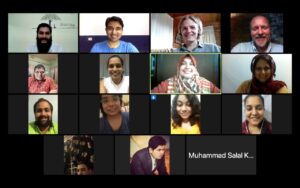
The ALLY young researchers’ project was not a typical training programme where you sit in front of a screen and go through hundreds of slides of theoretical learning. Instead, it was full of interactive sessions. The programme was designed in a way that it was both participatory and action-oriented, which was a thrilling experience.
As our training programme came to an end, we started preparing for the research interviews. At first, we thought about travelling across the country to conduct in-person interviews, but the Covid-19 situation was not in our favour. So, we decided to stick to online and phone conversations. I thought it would be tiring but those hours of long conversations were so inspiring and knowledge-producing. I discovered many dedicated young peacebuilders working silently across the country, whose minds are filled with creative ideas that are in need of a proper platform to flourish. I was surprised to know how each of them is contributing differently towards an inclusive society within their limited capacity. They might not have the resources to create a big impact, but they never lose hope to build a peaceful community.
I understood that peacebuilding is not a fancy, extracurricular thing. It is a burning passion among young people who seek a better and peaceful tomorrow.
Through the listening and learning methodology unique to this programme, I have become more of an empathetic listener and also increased the sense of community bonding. During the data sorting and writing process, the community feeling among the researchers also grew stronger. I remember those late night chitchats with Sameer and early morning conversations with Shafaq over WhatsApp. Those long calls with Sumaiya and Salal have been a great source of sharing and understanding all the information from different perspectives. In moments of stress, Kaush shared the art of coming up with simple solutions to every complex situation.
As all good things must come to an end, so did our journey of 10 months. Together, in those countless hours, we made many promises to each other and weaved thousands of dreams. It has been a journey that has taught me to reflect more on collective benefits. We might not have met in person, but we have formed a family of young, driven researchers building peace.
Written by Mohammad Rezwanur Rahman, ALLY young researcher from Bangladesh, inspired by his contribution to the ALLY research paper: Peace, My Heart