Intersectional Peacebuilding: An interview with Mohammad Shehadat
In this next blog post of our intersectional peacebuilding series, we interviewed Mohammad Shehadat, a young Syrian activist and co-founder of Youth for Peace Initiative (YPI) in Jordan. We sat down with Mohammad to discuss the intersections between disability, gender, and refugee status:
how our identities shape and drive our activism, and the approach that his initiative takes to increase accessibility, promote gender equality, and empower young changemakers across genders and disabilities.
Could you tell me a bit about your organisation and what led you to work on peacebuilding and focus on youth with disabilities?
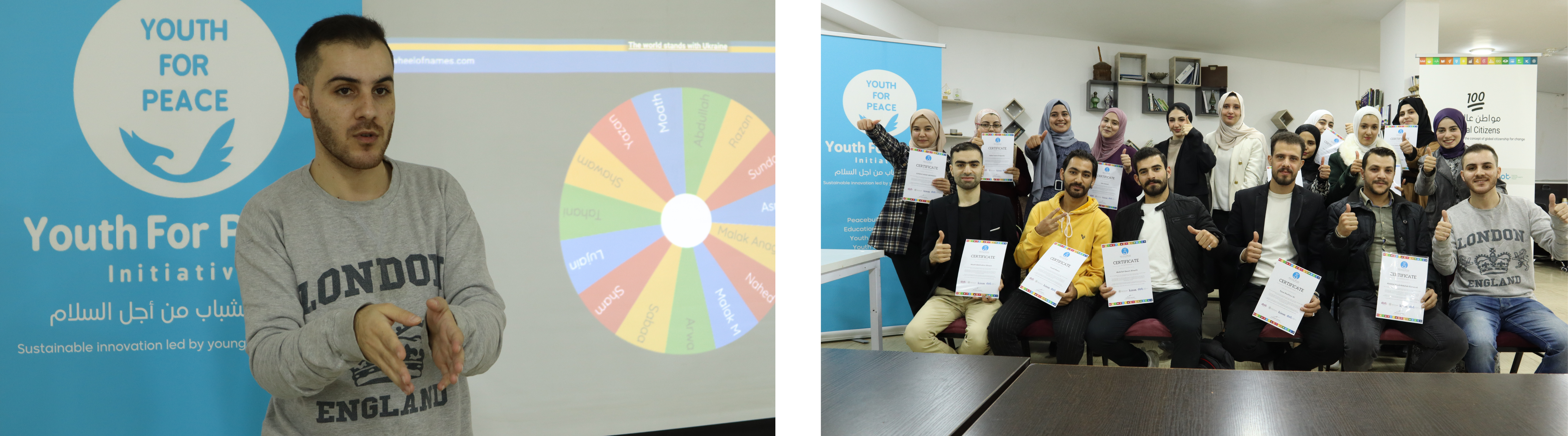
YPI works to engage Syrian refugee youth and Jordanian youth in peacebuilding activities. We were established in 2020 during the COVID-19 crisis to promote the values of peacebuilding activities, as we found it was a value that was missing in these communities. We focused mainly on displaced youth as Sarah Omar (co-founder) and I are displaced persons, and we lived in Jordan for many years as asylum seekers and clearly understood the challenges, circumstances, and the obstacles that young people face in these communities. We focus on driving this process with a different mindset: creating positive change and helping others to think in different ways. We strive and are keen to include disabled youth in our activities, and we are keen to enhance their roles and raise their voices as a part of our community and the process of making change. We share educational opportunities to engage young people in education as it is very important. You cannot make progress without helping people to create or build a mindset that is set on continuous learning. We have support from other partners such as NGOs that help us to create free access to courses and learning opportunities, and many of them are UNOY members as well.
What are some of the gender transformative projects Youth for Peace Initiative do?
Every year we participate in the WikiGap campaign, a global competition supported by the Swedish Ministry of Foreign Affairs. WikiGap works to promote the achievements of women around the world by improving and adding articles to Wikipedia to close its gender gap. It is important to highlight these achievements. Last year in Amman, Jordan, we participated and received an award from the Swedish and Canadian ambassadors.
We have also launched in Jordan a project called 100 Global Citizens, which works to promote global citizenship education and values among young refugees. When we launched this project, we selected an age group of 17 to 26 years but received many applications from women aged 30 to 35, who expressed interest in participating in these activities. They felt that these kinds of opportunities don’t exist in their communities and wanted to learn, so we invited them to participate. We hope to make 100 Global Citizens a sustainable project.
We focus on gender equality.
When we launched the Initiative, the first thing we were aware of was creating a code of conduct and a protection policy, especially for women. We are always trying to include young girls in our team to put forward the fact that women can not only be beneficiaries of projects but they can be change-makers. We work in this mindset because we understand the right of women to be in leadership roles.
It is often a challenge to engage cisgender men in gender transformational approaches. What advice would you give to encourage cisgender men to create alliances across genders and disabilities?
That’s an important question. As an activist, I founded the Initiative and support other awareness raising activities such as HeForShe. It is not just about speaking out for these issues, but it should become a key component of our character and our work. In our Initiative, we focus on engaging girls and women, as we believe they have the same challenges that men or boys have. My advice is to always engage girls not only as participants in activities but encourage them to use their voice as well. When you try to do that, you are a real advocate for them, and especially for refugees, who suffer from multiple challenges.
Can you tell me about some of the challenges you have faced in your peacebuilding work?
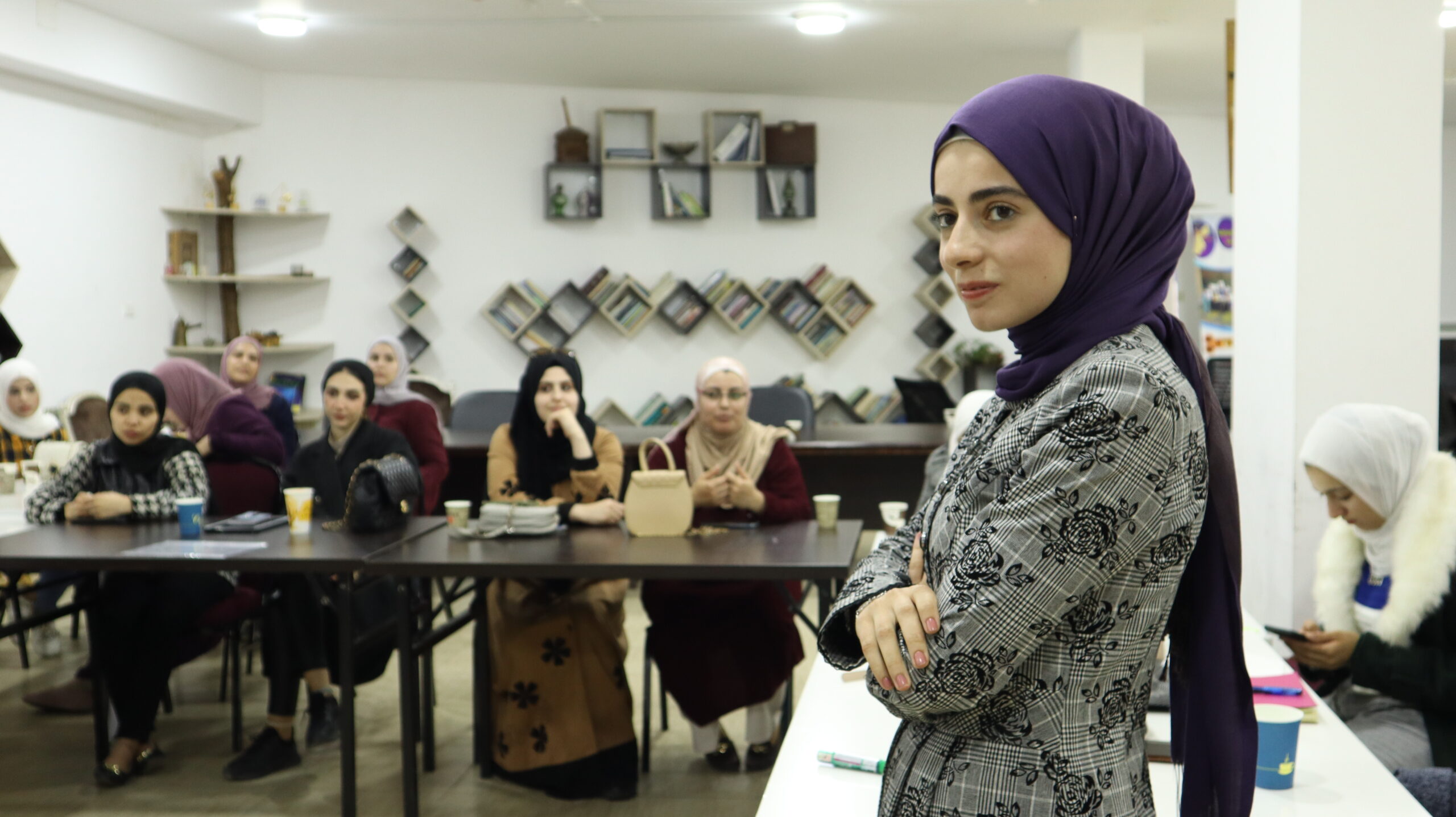
The main problem is our situation as refugees. As a refugee, your options become very limited. However, this doesn’t make us give up or forget. We faced mobility and networking issues. I remember I tried establishing partnerships with different entities and they always first ask whether we are registered legally. When I tell them, “No, but I believe in our impact, and we create amazing work” but this still becomes an obstacle. Yet we still have achievements that some registered organisations do not have. It comes down to our vision: we have a long-term vision to apply our initiative in Syria. This kind of initiative will be extremely needed after war. Rebuilding is not only about rebuilding the infrastructure or the houses, but it is a rebuilding of mindsets that show leadership.
There is a perception that most young peacebuilders are just activists that are well educated, as opposed to young people that have first-hand experiences of conflict.
Despite the fact that young peacebuilders face day to day problems, like mobility or accessibility, even conflict-affected and displaced young people can take up leadership roles and make a difference. Their experiences make them clearly understand the reasons for conflict. When I arrived at the refugee camp in the desert, I thought to myself, “I will spend my whole life in this camp” and was so uncertain about the future. This situation made me think about how I can take a role in resolving the crisis.
What are some of the good practices you have identified in your work?
I suggest making good practices a main principle in your work. Other people will be able to see clearly how you are working, including others, making successes that are not only for your organisation but for the individuals working with you.
Gender equality, for me, needs to be promoted everywhere beyond workplaces.
Especially in places where there are human rights violations experienced by women and girls, I know it is very hard to practise, and you will face challenges, but it is not impossible to fill this gap. I remember during the WikiGap campaign, I had heard people say, “You will never fill this gap”, or “who will care about these women?” But when we presented the results at the ceremony, it was surprising, as the number of articles we produced was unexpected. It was the first year we had such a large number of articles on the Wikipedia platform.
What future projects or changes do you hope to achieve this year?
We are thinking about awareness raising, storytelling, and communitarian movies. We need people that have expertise in filmmaking, creative writing, and communication to involve such creative young people and engage them in our work. We have a mutual goal and a mutual purpose: to develop ourselves, raise our voices, make progress in our communities, and to tell our stories as refugees. If we united our efforts, we could do it with huge interest, with real ideas coming from our hearts and the depth of our challenges. We have a lot of ideas, and new things are coming soon at Youth for Peace Initiative. For now, we are focusing on the idea of communitarian movies as a window into the situations of the people in Jordan and in other places.
Additional Resources
To learn more about Mohammad’s experiences, see the articles below on past and present peacebuilding projects:
https://www.unesco.org/en/articles/how-mohammad-helping-syrian-refugees-resume-their-education-gain-new-skills
https://www.kofiannanfoundation.org/our-work/kofi-annan-changemakers/
https://jordan.dotrust.org/story/mohammad-shehadat/
Are you interested in learning more about Gender Transformative Approaches?
Check out this resource: A Practical Guide to Gender Transformative Approaches for Youth Peace Organisations
Don’t forget to check out Youth for Peace Initiative Jordan on social media, or contact them at: youth4peace.jo@gmail.com
Socials:
Facebook: https://www.facebook.com/youth4peace.jo
Twitter: https://twitter.com/Youth4Peace_Jo
Instagram: https://www.instagram.com/youth4peace.jo/?hl=fr
Written by
Larissa Pietersma, UNOY Advocacy Officer
The header artwork used in this blog is the artwork of Amber Vittoria. The artwork was found on The Greats: a free vault with carefully curated socially engaged visual content open to anyone to use or adapt non-commercially for free under a Creative Commons Attribution-NonCommercial-ShareAlike 4.0 International license.